There's a moment that happens a few times every season somewhere in New Jersey: a food truck pulls up to an event, a property manager or fire official walks over, asks for a document the truck doesn't have, and the truck leaves. The host is left with 150 hungry guests and a vendor who swore they were "all set."
Almost nobody books a food truck planning to check fire permits. You shouldn't have to. But you should know what "all set" is supposed to mean — because the gap between a professionally run truck and a guy with a griddle and an Instagram page is invisible until the day of your event. This is the guide to that gap: what NJ actually requires, what insurance your venue will demand, and the specific questions that separate trucks worth booking from trucks worth skipping.
The thing nobody tells you: NJ has no statewide food truck license
Here's the structural problem underneath everything else. New Jersey doesn't issue one license that lets a truck operate everywhere in the state. Instead, a legally operating truck is holding a stack of overlapping approvals:
Health permits — issued locally. Food safety licensing runs through county and municipal health departments, and every jurisdiction does it separately. A truck fully licensed in Hudson County isn't automatically cleared to serve in Morris County. Trucks that work a wide territory maintain multiple health licenses, and fees vary enormously — from around a hundred dollars to over a thousand depending on the jurisdiction.
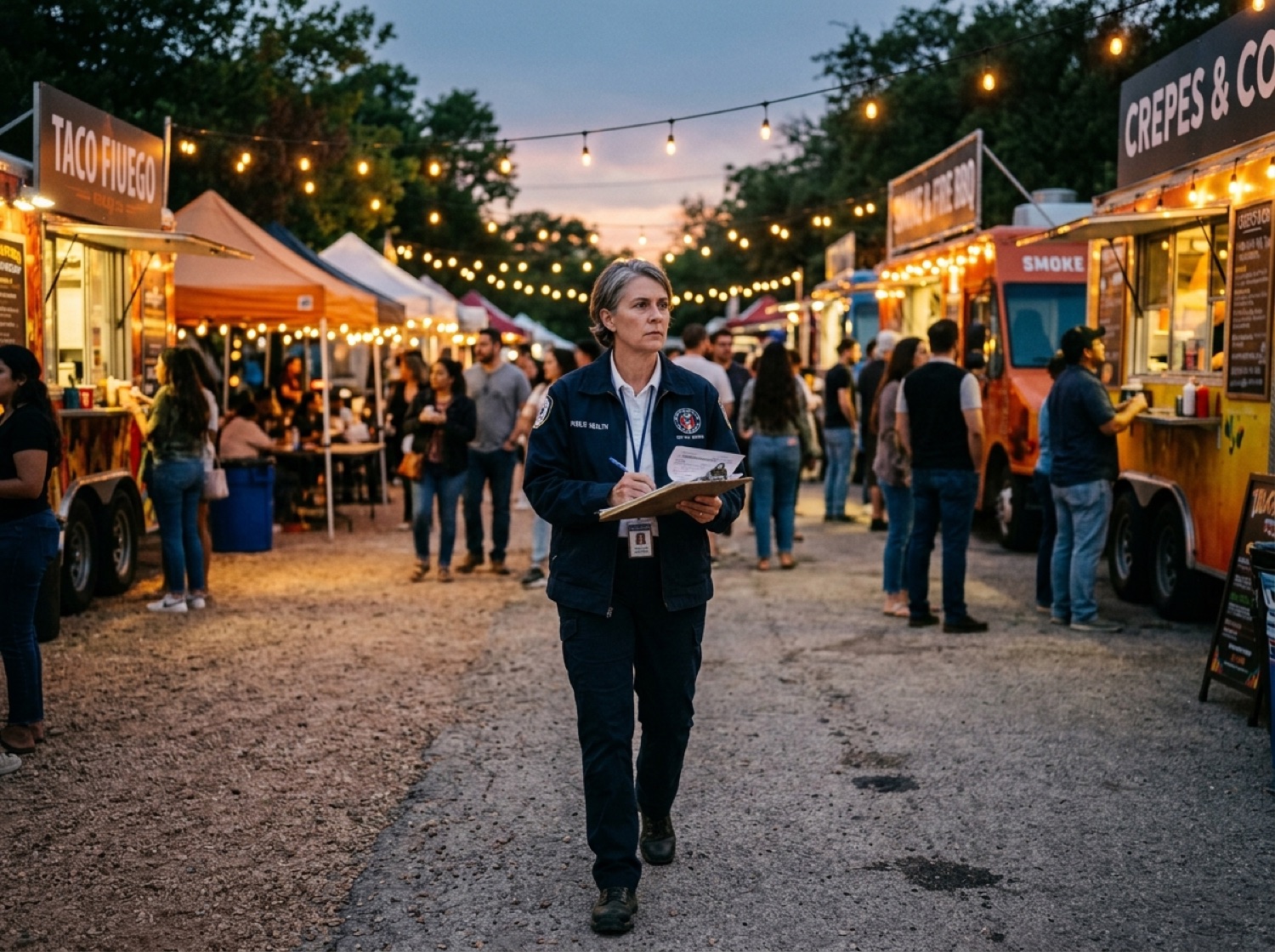
Fire permits — also local, plus state fire code. Trucks cooking with propane or open flame fall under the NJ Uniform Fire Code. Many municipalities require a fire permit (the state Type 1 mobile food unit permit runs about $54) and an inspection from the local fire prevention bureau covering propane mounting, hood suppression systems (which need inspection every six months), and Class K extinguishers.
Municipal vendor licenses. On top of health and fire, many towns require a peddler or mobile vendor license from the municipal clerk — and some towns cap how many they issue per year.
A commissary. NJ mobile food units must operate from a licensed base of operations — a commercial kitchen where the truck returns daily for cleaning, waste disposal, and food storage. A truck with no commissary answer is a truck preparing food somewhere it shouldn't.
The practical consequence for you: "we're fully permitted" is only meaningful relative to your specific town. A truck can be completely legitimate in twelve municipalities and still not be cleared for yours. The right question is never "are you permitted?" — it's "are you permitted to operate in [your town], and have you worked there before?"
The insurance your venue will ask about (and why it's non-negotiable)
If your event is at an office building, campus, club, or any managed property, insurance is the document that decides whether the truck gets in the gate.
General liability. The commercial-property standard in NJ — and nationally — is $1 million per occurrence / $2 million aggregate. Larger venues, universities, and corporate campuses sometimes require more. This is the policy that responds if a guest is injured or property is damaged in connection with the truck's service.
Commercial auto. A food truck is a vehicle, and a personal auto policy doesn't cover commercial food service operations. Trucks need commercial auto coverage for the driving and the vending.
Workers' compensation. Required in NJ for trucks with employees. Campuses and institutional venues frequently ask for proof.
The COI and "additional insured" — where bookings actually fail. Your venue won't take the truck's word for any of this. They'll require a certificate of insurance (COI): a one-page document from the truck's insurance agent showing active coverage, policy limits, and dates. And they'll almost always require the property owner and/or management company to be named as additional insured — an endorsement that extends the truck's coverage to protect the property itself.
Two failure modes show up constantly. First, the COI names the wrong entity — properties are owned by LLCs with names that don't match the building's sign, and "additional insured: 100 Main Street Office Center" doesn't help when the legal owner is "Main Street Holdings II, LLC." Second, the COI arrives the morning of the event, too late for the property's risk review. Either one can get a fully insured truck turned away.
A truck that handles corporate work regularly will have a COI with correct additional-insured language to your property manager within a day or two of being asked. A truck that goes quiet when you ask is telling you something.
What a real fire inspection covers (and why "10 feet" matters to your parking plan)
You don't need to learn the fire code, but two pieces of it reach into your event planning:
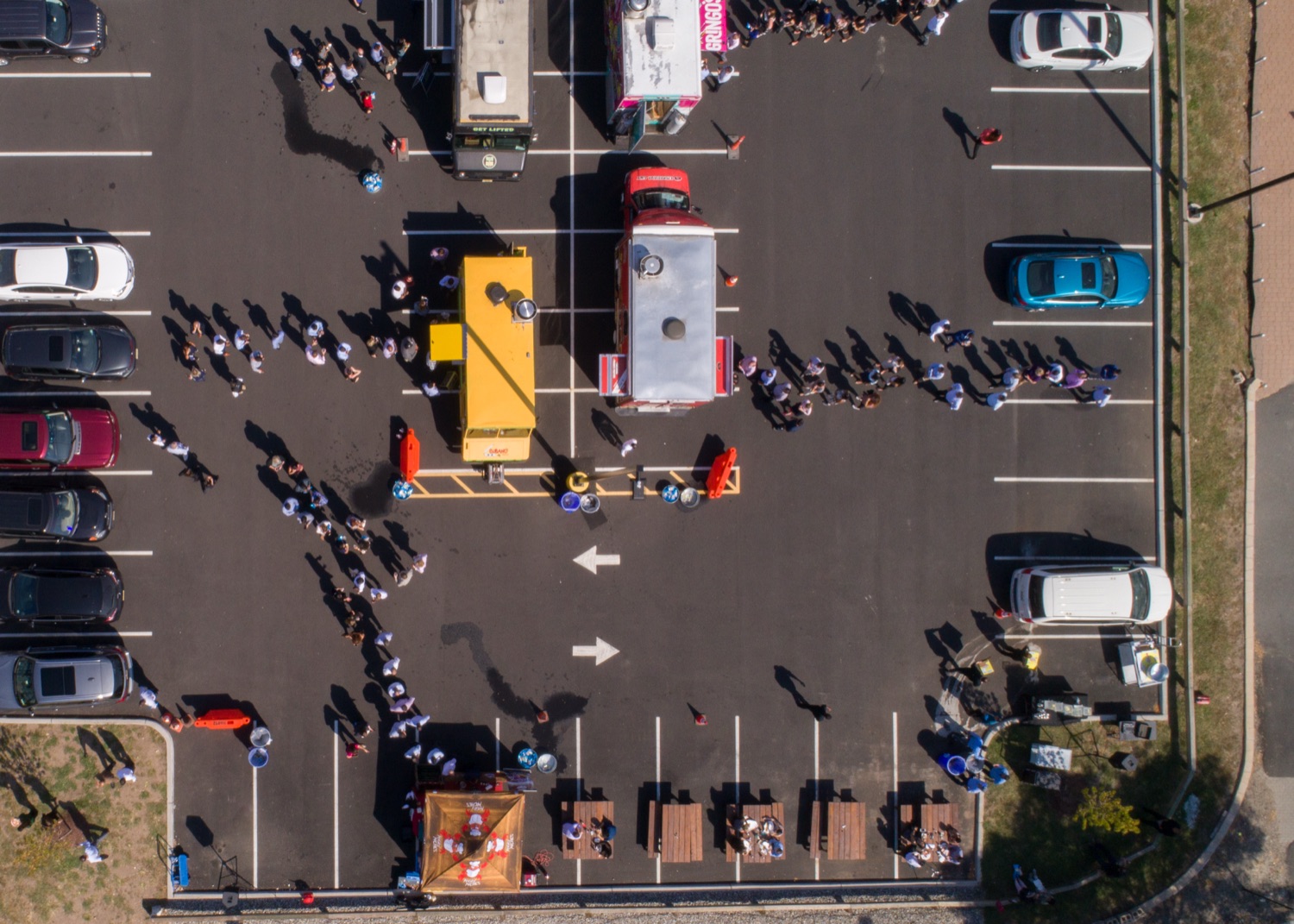
The 10-foot rule. NJ fire code requires food trucks to park at least 10 feet from buildings, structures, and combustibles. That perfect spot right against the lobby entrance? Not allowed. Plan the truck's position with that buffer in mind from the start and the fire marshal never becomes part of your day.
Propane done right. Compliant trucks carry propane in inspected, externally mounted (or vapor-sealed and vented) cylinders with a 125 lb maximum, run hood fire suppression with a current inspection tag, and carry Class K extinguishers for grease fires. You'll never check any of this yourself — but it's exactly what the local fire inspector checks, which is why "has this truck passed a fire inspection recently?" is a fair question to ask.
Five questions that sort professional trucks from everyone else
If you're booking a truck directly, these five questions take three minutes and prevent nearly every day-of disaster:
- "Are you licensed to operate in [town], and when did you last work there?" Listen for a specific answer, not a general "we're all permitted."
- "Can you send a COI naming our property as additional insured by [date]?" Any hesitation is disqualifying for a commercial venue.
- "What's your commissary?" Every legal NJ truck has an immediate answer.
- "When was your last health and fire inspection?" Recency matters; suppression tags expire every six months.
- "What happens if your truck breaks down the morning of our event?" The honest answer from a solo truck is "we'd have to cancel." That's not a character flaw — it's just the structural risk of booking one truck with no network behind it.
None of this is about catching vendors in lies. The large majority of NJ food trucks are well-run small businesses. It's about the timing problem: every one of these gaps is invisible when you book and catastrophic when it surfaces at 11am on event day.
What we handle so you don't have to
This entire article is a list of things Food Trucks On The Move does before you ever see a quote.
Every truck in our network is vetted before they take a single event — licensing, insurance, commissary, inspection history. When you book through us, we match trucks that are already cleared for your municipality or we handle the local permitting conversation ourselves. We get the COI issued with your property's exact legal entity named as additional insured and into your property manager's inbox ahead of their deadline. And because we coordinate a full network rather than one truck, a morning breakdown means we're calling our bench — not calling you to cancel.
One coordinator, one quote, full permits and insurance. You plan the headcount; we carry the clipboard.
FAQ
Do food trucks in NJ need a permit for a private event on private property?
Often, yes. Even on private property, most NJ municipalities require trucks to hold local health and fire approvals, and some require an event-specific permit. It varies town by town — which is exactly why you confirm it per-event.
What insurance should I require from a food truck?
General liability at $1M per occurrence / $2M aggregate minimum, plus commercial auto. Require a COI naming your property's legal entity as additional insured, delivered before the event — your property manager will tell you the exact entity name and any higher limits.
Who is responsible if a food truck shows up without the right permits?
The truck holds the legal responsibility, but you absorb the practical consequence — a canceled lunch. Verifying ahead of time (or booking through a coordinator who has) is the only real protection.
How do I verify a food truck's permits myself?
Ask for their license for your specific municipality and their latest inspection dates, and ask your local health department to confirm if you want certainty. Or skip the homework by booking through a network that vets this before listing a truck.
Does my homeowner's or business insurance cover the food truck?
No — the truck's own policies cover its operations. Your role is requiring proof (the COI), not extending your coverage.
What does "additional insured" actually mean?
It's an endorsement on the truck's liability policy that extends protection to your property or company for claims arising from the truck's work at your event. It costs you nothing and venues require it for good reason.